
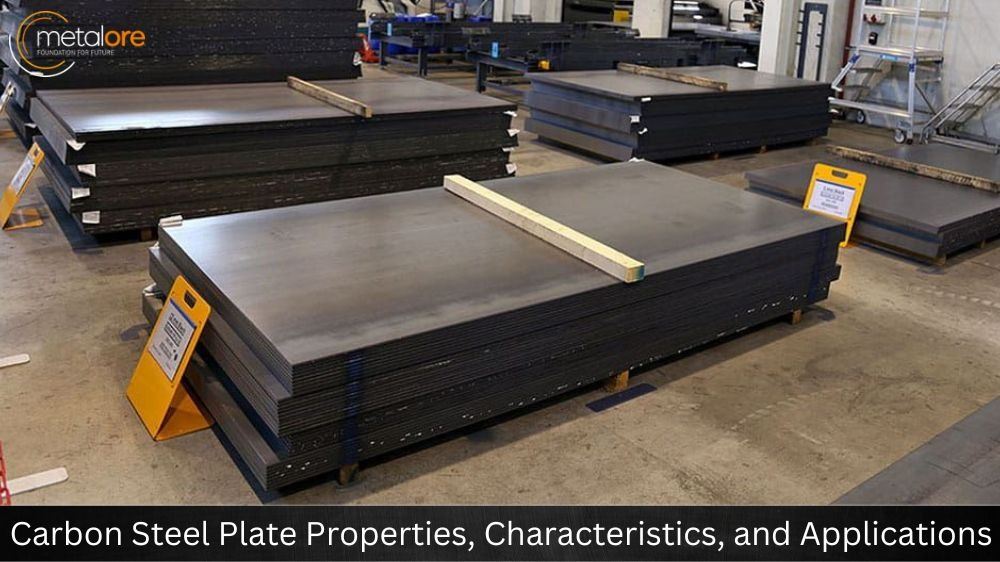
Few materials stay as consistently useful across so many industries as carbon steel plate. It holds up in construction, heavy manufacturing, pressure containment, and transport infrastructure, all without requiring specialist processing or complex supply chains. That reliability, combined with manageable fabrication costs, is why it stays a standard choice.
What is a Carbon Steel Plate?
It is resistant to construction, heavy manufacturing, pressure containment and transport infrastructure without the need for specialist processing or complex supply chains. Mainly, its carbon level makes it different from low-alloy and stainless. Higher carbon raises hardness and wear resistance. It also makes the material easier to machine, drill, and cut using standard tooling.
Properties of Carbon Steel Plates
Physical Properties of Carbon Steel Plate
Carbon steel plate handles both thermal cycling and heavy mechanical loads without significant dimensional change. Thermal expansion stays low compared to aluminium and copper alloys, which matters in applications with repeated heating and cooling. Hardness covers a wide range: around 150 HB in mild grades, rising to 700 HB and above in wear-resistant grades. Higher-hardness plates retain their strength after rapid quenching. Corrosion resistance depends on grade and surface treatment. In dry or controlled environments, most carbon steel plates perform reliably without additional coating. Formability across mid-carbon grades is good enough to allow rolling, pressing, and welding without cracking at bend lines.
Mechanical Properties of Carbon Steel Plate
Tensile strength runs between 400 MPa and 690 MPa depending on grade. Yield strength is lower than tensile, which gives the material some tolerance under sudden loading. That combination of ductility and toughness suits applications where impact matters alongside raw strength. Weldability is practical. At lower carbon levels, most grades join reliably using standard arc welding without pre-heat. Wear resistance improves with higher carbon content, which is why high-carbon plates are used in mining equipment, earth-moving attachments, and conveyor systems where abrasion is constant.
Characteristics of Carbon Steel Plates
Carbon steel plates need surface protection in wet or chemically active environments. That is a clear limitation. What keeps them useful is fabrication flexibility. A single grade can be plasma-cut, flame-cut, hydraulically formed, drilled with standard tooling, and joined by several welding methods. That range of options simplifies project planning and reduces fabrication costs at scale. Plates also follow internationally recognised standards like ASTM A36, IS 2062, and EN 10025, so procurement teams can specify by standard rather than custom spec. This keeps sourcing straightforward across different suppliers.
Applications of Carbon Steel Plates
Construction takes a large share of carbon steel plate use. Structural beams, bridge girders, column base plates, and gantry frameworks all rely on its load-bearing capacity. In manufacturing, it goes into crane booms, excavator buckets, bulldozer blades, and press frames. For pressure and storage applications, grades like ASTM A516 handle vessels and tanks for gases and liquids at elevated temperatures.
In the rail and automotive industries, fatigue resistance and impact performance are more important than weight, so carbon steel plates are used in the chassis components, railway track base plates and wagon floors. In each case, the material holds its place for the same reasons: consistent mechanical performance, wide availability, and cost-effective fabrication.
Speak to your supplier with the specific grade, thickness, and cut dimensions your project needs to confirm stock and lead times.
Conclusion
Carbon steel plates cover a wide spread of industrial requirements, from mild structural grades at 150 HB up to abrasion-resistant options exceeding 700 HB. Strength, durability, and fabrication flexibility come at a cost structure that holds up at scale. Carbon steel plate is still the practical and proven choice for many applications that require uniform mechanical properties without special processing. Ask your supplier about lead times and availability for the grade, thickness and dimensions you require for your application.