
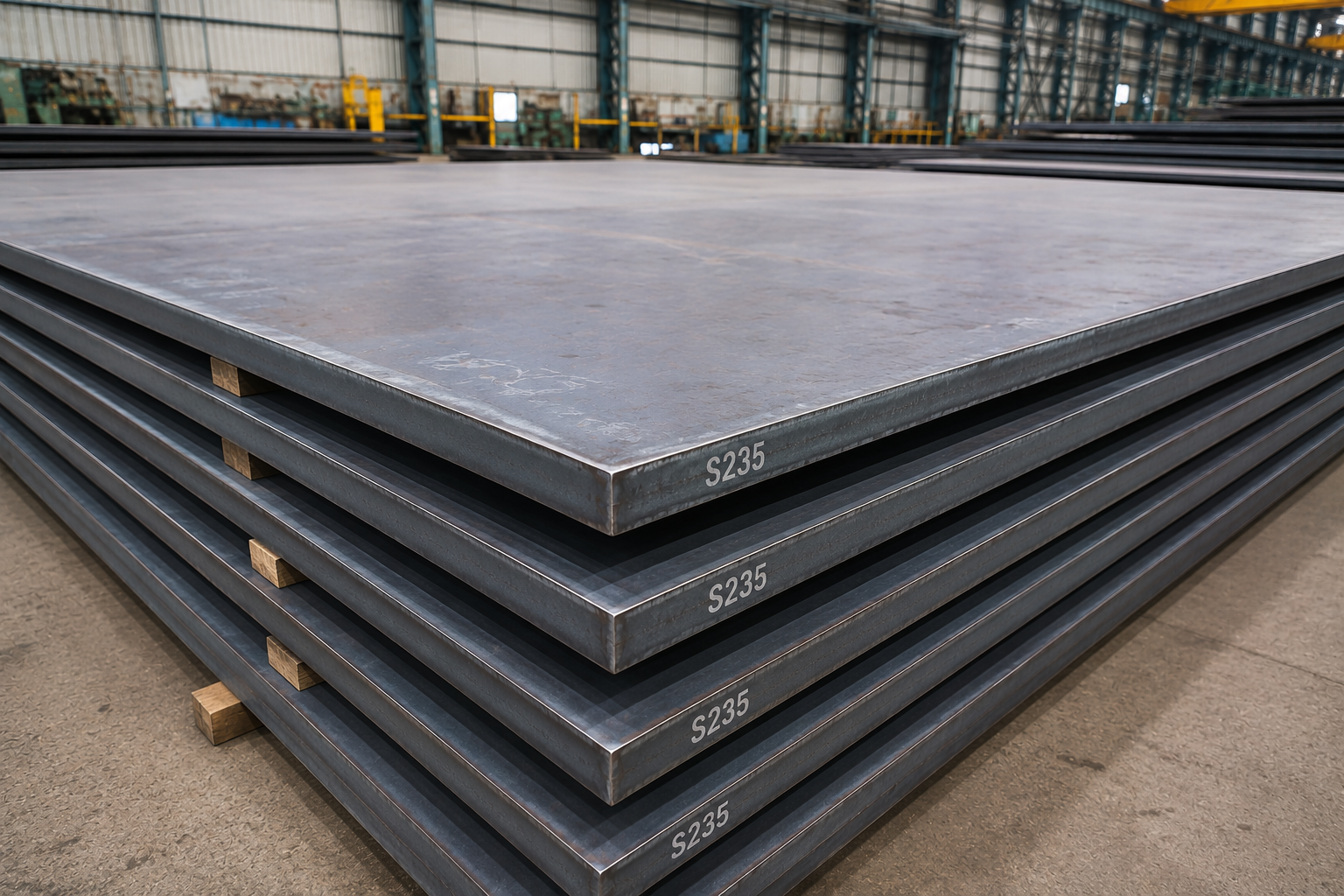
S235 remains the default specification on structural drawings across fabrication shops, largely because it welds without preheating and costs less per ton than higher-strength alternatives. Engineers apply this grade to support beams, machinery frames, and storage vessels where 235 MPa yield strength covers the load. This guide sets out the specifications, mechanical properties, applications, and benefits of steel plate S235, and shows how it compares against S355 for project selection.
What Is S235 Steel Plate?
EN 10025 governs this grade, the European standard for hot-rolled structural steel products. Within that standard, “S” marks a structural grade and “235” sets minimum yield strength at 235 MPa for material up to 16 mm thick, decreasing incrementally with increased thickness. Welding needs no preheat in standard sections, and punching, bending, and machining proceed with ordinary shop tooling. Fabricators building platforms, brackets, and equipment supports specify S235 steel plate because the strength matches the load without adding fabrication steps.
Specifications of S235 Steel Plate
Three grade variants sit under EN 10025-2: S235JR, S235J0, and S235J2, each with different impact-testing requirements. Delivery comes as-rolled or normalized, across plates, sheets, and structural steel plate sections.
| Specification | Details |
| Standard | EN 10025-2 |
| Common Grades | S235JR, S235J0, S235J2 |
| Delivery Condition | As-rolled or normalized |
| Classification | Non-alloy structural steel |
| Product Forms | Plates, sheets, structural sections |
Key Mechanical Properties of S235 Steel Plate
Elongation at break runs around 26 % for standard plate thickness, showing how far the material stretches before fracture. Combined with a yield strength of 235 MPa and tensile strength between 360 and 510 MPa, these figures explain why the grade suits general fabrication rather than high-load engineering.
| Property | Industrial Benefit |
| Good Yield Strength | Suitable for structural applications |
| Excellent Weldability | Easy fabrication and assembly |
| Good Ductility | Better forming capability |
| Reliable Tensile Strength | Supports structural loads |
| Good Machinability | Efficient manufacturing |
| Cost-Effective | Lower project costs |
Benefits of Using S235 Steel Plate
Four factors set this grade apart in daily shop use: welding ease, forming tolerance, consistent load capacity, and a lower price than premium steels.
Excellent Weldability
MIG, TIG, and stick processes work on this grade without preheating in sections up to 30 mm. Weld beads stay consistent from batch to batch, which matters on repetitive joints within one order.
Good Formability and Machinability
Standard shop tooling handles this steel without upgrades. Drills, punches, and press brakes cut, pierce, and bend it at typical structural radii without cracking. Fabricators work directly from drawings, skipping tooling changes that stronger grades sometimes need.
Reliable Structural Performance
At 235 MPa minimum yield, this plate handles the loads found in general construction and machinery framing. That figure holds steady from mill to mill under EN 10025-2 testing, so engineers can size a structure consistently across suppliers.
Cost-Effective Material
This grade is significantly more cost-effective per ton than S355 or corrosion-resistant nickel and chromium alloys. On large-scale procurements, this price differential yields substantial cost savings, preventing unnecessary expenditure on structural strength exceeding the project’s requirements.
Common Applications of S235 Steel Plate
Construction, machinery building, tank fabrication, material handling, and bridge work account for most demand for this grade, each relying on this grade for to its strength and welding ease.
Structural Steel Fabrication
Beams, columns, and welded frames account for most structural fabrication work in this grade. Standard cutting and welding methods apply, and consistent properties across plate thickness keep quality control simple.
Buildings and Construction
Low and mid-rise buildings put roof trusses, frames, and support columns in this grade, matched to a 235 MPa yield for those loads. Contractors also gain from lower material cost on large orders.
Industrial Machinery
Manufacturers machine S235 into equipment frames, machine bases, and protective housings, taking advantage of its strength and drillability. Cutting, drilling, and welding need no extra steps, which shortens production schedules.
Storage Tanks
In storage tank fabrication, S235 handles shells and support structures where corrosive exposure stays limited. The steel welds into leak-tight seams and holds its shape under stored liquids or bulk materials.
Material Handling Equipment
Repeated loading without fatigue makes S235 suitable for conveyor frames, racking systems, and lifting equipment at moderate stress levels. Its weldability also allows quick repairs on equipment already in service.
Bridges and Infrastructure Projects
When project loads stay within its yield range, S235 works well for pedestrian bridges, guardrails, and infrastructure supports. The grade meets standard structural codes while keeping project costs below higher-strength alternatives.
S235 Steel Plate vs Higher Strength Structural Steel Grades
S355 delivers 120 MPa more yield strength than S235 steel plate, at a higher price and reduced formability. The decision comes down to whether the load genuinely needs that extra margin.
| Feature | S235 Steel Plate | S355 Steel Plate |
| Minimum Yield Strength | 235 MPa | 355 MPa |
| Weldability | Excellent | Excellent |
| Formability | Excellent | Good |
| Structural Strength | Moderate | Higher |
| Best Applications | General fabrication and construction | Heavy-duty structural projects |
| Cost | More economical | Higher |
Conclusion
Across construction, machinery, tanks, and material handling, S235 steel plate covers the majority of general fabrication work without the price premium of S355 or specialty alloys. Weldability, formability, and a minimum yield of 235 MPa certified to EN 10025 make it the default choice when loads stay moderate. Metal Ore stocks certified S235 plates with mill test certificates on every batch. Check current stock and specifications before you finalize a project order.